What better way to celebrate International Dog Day than by catching up with our very own Rachel from the HILS Advocacy Team? Rachel has been volunteering with Guide Dogs for many years, supporting the charity’s incredible work and helping to make a difference to the lives of people with sight loss. We asked Rachel about her volunteering journey, what inspires her, and what it’s really like to be involved with Guide Dogs.
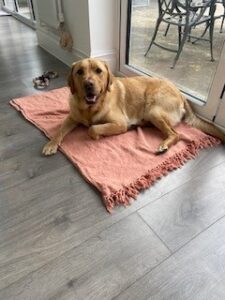 What inspired you to become involved and how long you’ve been doing it?
I became a volunteer fosterer in 2021. Over dinner one night a long-standing friend of mine kept talking about “the dog did this, and the dog did that” and I suddenly twigged ‘but you don’t have a dog’. I asked loads more questions and it transpired that she was a volunteer fosterer for Guide Dogs UK. I came away from the dinner table that night with the concept playing repeatedly in my head. I thought this could be the perfect compromise for our family. So I reached out and started the application process.
It has been everything I hoped it would be and more. It brings all the joy of having a dog in your home without any of the expense as Guide Dogs UK pay for everything and provide you with everything the dog needs. Also, when the dogs are ready for training they are between 12 and 14 months old so they are already toilet trained, can walk nicely on a lead and have been socialised. This was ideal information for persuading my slightly reluctant husband to jump on board with my idea!
What does a typical day look like when you’re looking after and training a future guide dog?
Monday to Friday from 9am to 5pm the dogs go to training school in St. Albans. So during the week my input is minimal. Breakfast, toileting, the school run, dinner, toileting, sleep, repeat. At the weekends I take them on walks and they spent some time off the lead called ‘a free run’.
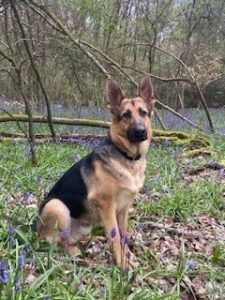 What are some of the most important skills puppies learn during their early training?
We mainly teach them how to behave and be a good companion in a home environment. For example, not being under someone’s feet when they are cooking, not begging for food or crumb-hunting around the table when people are eating, being calm when guests visit, getting in and out of cars etc.
Is there a particular dog or moment that has stayed with you and why?
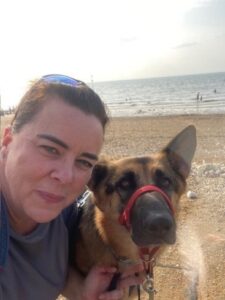
We had a German Shepherd called Pacer for 19 months. She was withdrawn from the guiding programme so whilst she was waiting for her forever home she only had to go to training school once a week. It took a long time to find her forever home (which she found in December 2025 and she’s absolutely thriving by the way). Because of the length of time she was with us, she definitely left an imprint on my heart.
What’s the most rewarding part of watching a puppy progress through training?
It’s rewarding to see them progress in general and get matched with a visually impaired person.
It must be difficult to say goodbye when a puppy moves on. How do you manage that part of the journey?
This has to be the most common question I get asked. It is hard and there are tears every time. We’re on dog number 5 now. But we went into this with our eyes wide open. The mantra in our house that gets us through this stage is “Someone needs this dog more than we do.”
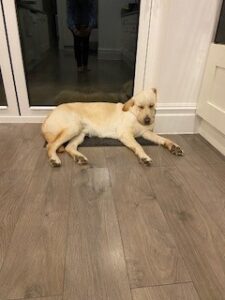 How do guide dogs change the lives of the people they’re matched with?
There’s thousands of stories of visually impaired people who’s lives have been positively impacted by having a guide dog. Some people suffer with poor mental health or become reclusive and agoraphobic after losing their sight. A guide dog can positively impact every aspect of their lives – giving people their independence back and improving their mental health.
What would you say to someone who’s interested in volunteering but isn’t sure whether they could commit the time?
Guide Dogs UK relies on volunteers through every part of a dog’s life and the time commitment varies greatly. From breeding fosterers (ie. you provide a full-time home to the female throughout her pregnancy, the birth and then you look after the puppies until they’re 12 weeks old), puppy raisers (the volunteers who look after dogs from 3 to 12 months), training fosterers like me and then people who re-home retired or withdrawn dogs. You could be a temporary training fosterer – so when people like me go away overnight or for a few days then our dog goes to a temporary training fosterer. So a bit like holiday cover I guess!
Rachel’s Rapid round:
– Favourite puppy training success?
Together with the trainer, we managed to get Terry jumping into and out of the car happily after 7 days. This was a big win.
-Funniest thing a puppy has done?
Stealing socks out of the laundry basket!
-How many pairs of shoes have been sacrificed during training?
Actually – 0. Hats off to the volunteer puppy raisers as I think they face this type of behaviour every day.
-Who have you got currently?
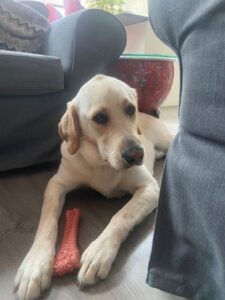 Right now we have Terry. We’ve had him for 7 weeks now and considering the fact that during week 1 I spent 30 minutes trying to get him into the car and now he jumps in (and out) without a 2nd thought ….. I’m chuffed to bits. If someone could please stop him shedding so much that would be great!

Interested in volunteering with Guide Dogs? Volunteering Opportunities | Guide Dogs UK
A huge thank you to Rachel for sharing her experience and helping us celebrate International Dog Day. If you or someone you know could benefit from support to understand information, make informed decisions, or have their voice heard, our Advocacy service may be able to help. Find out more about the service and the different ways to get in touch below.
If you think you would benefit from our Advocacy service, please contact POhWER. There are different ways to get in touch:
- Call the Help Hub on 0300 456 2370 (charged at your standard network rate), open from Monday to Friday 8am to 6pm
- Email hertsadvocacy@pohwer.net
- Text the word ’pohwer’ with your name and number to 81025